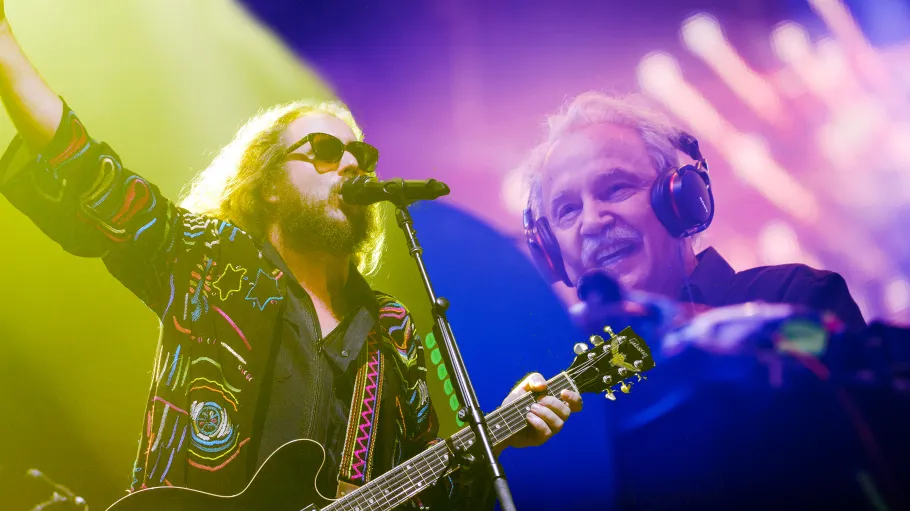
Close your eyes and think of the relentless, ticking clock tension in a Christopher Nolan masterpiece. Whether it is the sands of time slipping away in Dunkirk or the distorted memories of Inception, there is a pulse—a mechanical, hypnotic, and synthesized heartbeat that drives the narrative forward. You might think this sound was born in a modern high-tech Hollywood studio, but you would be wrong. This sonic DNA originated in the neon-soaked, smoky atmosphere of a 1970s disco club, pioneered by a legendary architect of sound named Giorgio Moroder.
Long before he was influencing the greatest directors of the twenty-first century, Giorgio Moroder was the man who traded the warm, organic hum of the guitar for the icy, futuristic precision of the synthesizer. In the mid-1970s, while the world was obsessed with the disco fever of Studio 54, Moroder was buried in his Munich studio, pushing the boundaries of what a machine could do. When he produced Donna Summer’s I Feel Love, he created more than just a dance floor hit; he crafted a repetitive, driving sequence that felt like the future arrived early. That track was the blueprint, a relentless electronic pulse that would eventually find its way into the very soul of modern cinema.
It is fascinating to trace the lineage from a sweaty 1970s nightclub to the cold, calculated suspense of a modern blockbuster. The connection is rooted in that specific, unchanging tempo—the signature sound of Giorgio Moroder. Nolan, a director known for his obsession with time, structure, and psychological complexity, found the perfect musical companion in the ethos of early electronic composition. By stripping away the bloated orchestral arrangements of the past, Moroder proved that a single, looped electronic sequence could induce more anxiety and excitement than a hundred-piece string section. This is the secret weapon of the blockbuster: the Giorgio Moroder influence.
In the eighties, the sound of the Walkman became the soundtrack of a generation, and Giorgio Moroder was at the helm, scoring films like Midnight Express and Top Gun. He understood better than anyone that music is not just background noise; it is the subconscious driver of human emotion. He took the experimental spirit of the disco era and polished it into a tool of narrative precision. Today, when you hear those rhythmic, pulsing basslines echoing through a theater, you are hearing the ghost of the synthesizer revolution that he ignited decades ago. It is a testament to his genius that a sound designed to keep people dancing is now used to keep audiences on the edge of their seats.
As we look back at the history of American music and its crossover into global pop culture, it is easy to focus on the icons who stood in the spotlight. Yet, it is the innovators like Giorgio Moroder who truly defined how we hear the world today. His work bridge the gap between the decadence of the disco age and the intellectual rigor of modern film. Next time you sit down to watch a thriller and feel that familiar, thumping pressure building in your chest, remember the disco legend who paved the way. History has a funny way of echoing through the speakers, and for the modern cinema lover, that echo sounds exactly like a Giorgio Moroder beat.