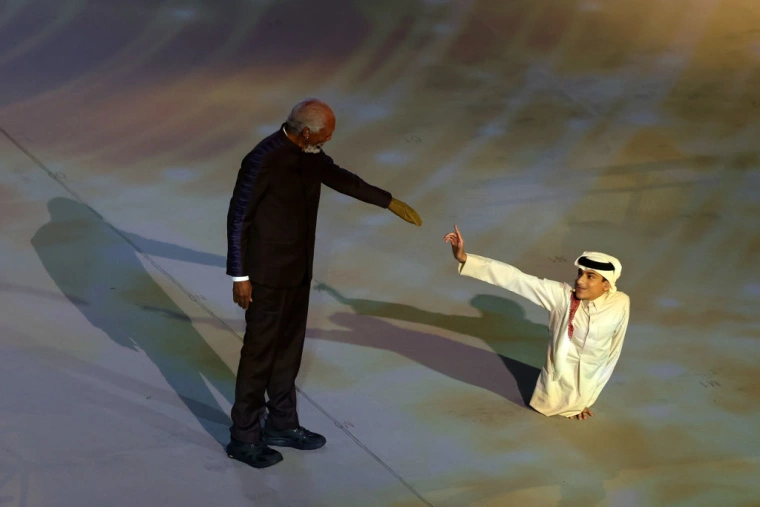
Before Lionel Messi lifted the World Cup in Qatar, the evening had already been given a voice. It was not the roar of a striker or the crackle of a commentator, but the calm, unmistakable sound of Morgan Freeman. At the Qatar 2022 World Cup opening ceremony, Freeman’s presence felt like the curtain rising on an old Hollywood epic, preparing the world for a story that had been waiting decades for its final scene.
For audiences who grew up with the great American movie stars of the 1950s through the 1990s, Morgan Freeman carries a particular kind of authority. His voice seems carved from experience, gentle but immovable, the sort of voice that can make a simple sentence feel like a passage of scripture. By 2022, he was not merely an actor from films such as Driving Miss Daisy, The Shawshank Redemption, and Million Dollar Baby. He was a familiar companion, a narrator of memory itself.
That is why his appearance in Qatar lingered. Standing in the vast glow of Al Bayt Stadium, Morgan Freeman spoke of unity, welcome, and the shared human road. Beside Qatari ambassador Ghanim Al Muftah, he helped frame the tournament as something larger than sport. The moment had the mood of a prologue, like the first minutes of a grand motion picture, when the music swells and we understand that ordinary time is about to give way to legend.
And then came Lionel Messi. For years, Messi had been football’s quiet artist, a man whose genius often seemed less performed than revealed. He had dazzled in Barcelona colors, broken records, endured heartbreak with Argentina, and carried the burden of comparison with the ghosts of football history. In Qatar 2022, every match seemed to pull him closer to destiny. By the time Argentina faced France in that unforgettable final, the tournament had become a drama worthy of the finest cinema.
The connection between Morgan Freeman and Lionel Messi was not a partnership in the usual sense. One belonged to Hollywood, the other to the green field. Yet their names now meet in the memory of Qatar 2022 because both represent something increasingly rare: grace under the gaze of the whole world. Freeman gave the opening its moral and cinematic tone. Messi gave the ending its tears, tension, and triumph. Together, they bracketed a World Cup that felt written for the ages.
Looking back from 2026, the beauty of that night remains. We remember the amber lights, the measured voice, the stadium shaped like a Bedouin tent, and later, the image of Lionel Messi finally holding the trophy that had eluded him for so long. Morgan Freeman’s call for unity did not settle every argument surrounding the tournament, but it offered a dignified beginning. And when Messi’s coronation arrived, the story felt complete: one Hollywood legend, one football immortal, and a world briefly gathered around a shared dream.