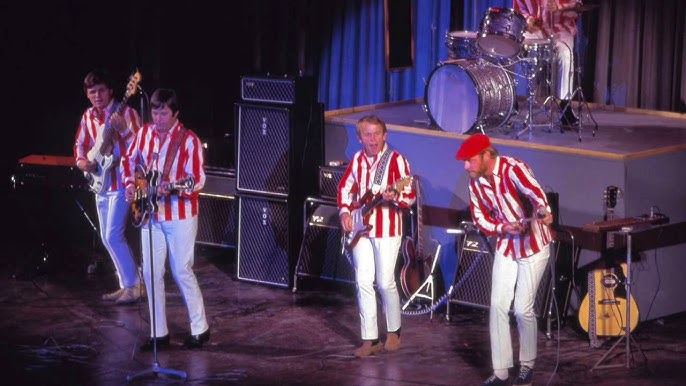
It was 1966, the year the world seemed to turn on a different axis. While teenagers were busy threading ribbons through their hair and the airwaves crackled with the static of transistor radios, a masterpiece was being stitched together in a series of disparate, smoke-filled recording studios. Most listeners heard Good Vibrations and felt only the sunshine, the California surf, and the ethereal vocal harmonies that seemed to drift down from the heavens. Yet, beneath that polished, sun-drenched exterior, Brian Wilson was orchestrating a nervous breakdown in slow motion, pushing the boundaries of what a pop song could actually be. This wasn’t just a hit; it was a psychological sonic puzzle that changed music history forever.
To understand the magnitude of Good Vibrations, you have to transport yourself back to an era when the Jukebox was king and every chord progression was a battleground for innovation. Brian Wilson, the mastermind of The Beach Boys, was locked in a private war of perfectionism, obsessed with turning the studio into an instrument itself. He didn’t want to just record a track; he wanted to capture a feeling that transcended the standard three-minute pop format. He cut the song into tiny, fragmented pieces of tape, a process so grueling and revolutionary that it left everyone around him breathless. It was the ultimate studio experiment, a mosaic of sound that demanded hundreds of hours of labor to achieve three minutes of perfection.
Yet, the true tragedy of this legendary track lies in the cost of that genius. As The Beach Boys climbed the charts, the pressure of maintaining that level of creative output began to shatter Wilson’s fragile psyche. He was hearing symphonies in his head that the technology of 1966 could barely contain, and the isolation of the studio became his sanctuary and his prison. While the public danced to the song’s infectious rhythms, the man behind it was spiraling into the dark corners of his own mind, haunted by the very expectations he had created. It is a classic tale of the artist’s burden—where the most beautiful art often blooms from the deepest internal fractures.
Decades later, the song remains an untouchable titan of the airwaves. Why does it still vibrate through our cultural consciousness? Perhaps it is because it represents the last gasp of pure, unadulterated optimism before the turbulent cultural shifts of the late sixties took full hold. Even today, the hum of the organ and that distinctive, eerie theremin-like sound—created by the electro-theremin—transport listeners back to a lost version of America. It reminds us of a time when melody reigned supreme and a single song could define the identity of an entire generation.
When we listen to Good Vibrations now, we aren’t just hearing a pop anthem; we are hearing the sweat, the struggle, and the sheer, uncompromising vision of a man pushing himself toward the edge. It stands as a monument to the golden age of American rock, a shimmering jewel that refuses to fade despite the shadows that once surrounded its creation. The next time those iconic harmonies swell, take a moment to remember the chaos required to craft such perfect, timeless peace. It truly is a miracle of sound that we are lucky to still possess.