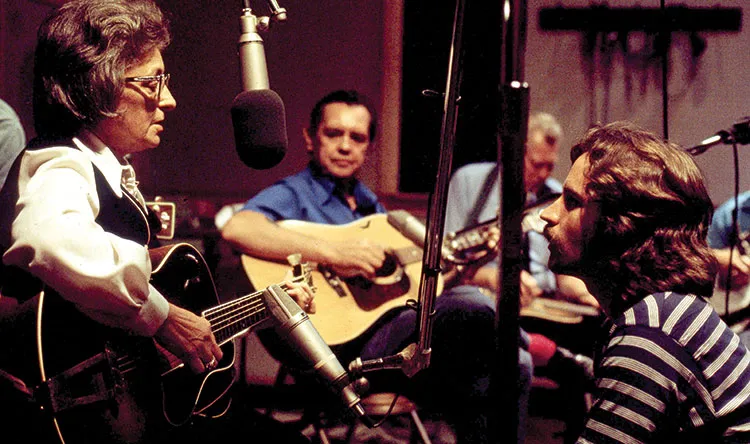
The year was 1972, and the air inside the Nashville studio was thick with more than just the smell of stale coffee and cigarette smoke. It was pregnant with a generational divide that defined the early seventies. On one side stood the Nitty Gritty Dirt Band, a collective of long-haired, denim-clad hippies from California who looked more at home at Woodstock than in the hallowed halls of country royalty. Across the room, a legendary titan of traditional country music stood with his arms crossed, staring at these youths with a gaze that suggested he had walked into the wrong building. He didn’t just dislike their music; he openly despised their aesthetic, famously threatening to walk out rather than record with what he called those long-haired hippies.
This tension was the backdrop for what would eventually become a landmark project in American music history, the triple album Will the Circle Be Unbroken. The Nitty Gritty Dirt Band had a radical vision: to bridge the chasm between the old guard of Grand Ole Opry staples and the burgeoning folk-rock movement. But in the early hours of that session, the gap felt insurmountable. The traditionalists viewed the Nitty Gritty Dirt Band as interlopers, outsiders who lacked the reverence required for the sacred roots of bluegrass and mountain music. The atmosphere was brittle, and a single wrong note threatened to collapse the entire ambitious experiment before it even began.
Then, the silence was shattered by a blistering instrumental performance. As the Nitty Gritty Dirt Band launched into a feverish, technically precise, and soulful bluegrass tune, the mood in the room shifted instantly. The skepticism in the room evaporated, replaced by a stunned, reluctant respect. The country legend who had been ready to bolt for the door found himself mesmerized by the raw, kinetic energy they were channeling. It was a moment of pure musical alchemy where the generational barriers dissolved into thin air, proving that talent and a shared love for the tradition could speak louder than haircuts or cultural politics.
That session forever changed the trajectory of the Nitty Gritty Dirt Band and the perception of American roots music. By bringing these disparate worlds together, they created a sonic time capsule that preserved a dying breed of mountain virtuosos while introducing them to a new generation of listeners who grew up with the sounds of the radio and the warmth of a spinning Jukebox. It captured a fleeting intersection of history where the rigidity of the past met the restless innovation of the future, creating something that felt timeless, honest, and profoundly human.
Looking back, the story of the Nitty Gritty Dirt Band serves as a poignant reminder of why music remains our most powerful universal language. It wasn’t just about the notes or the chords; it was about the collision of egos, the breaking down of stereotypes, and the eventual realization that art is the only true equalizer. Whenever we revisit those crackling records today, we are reminded that even the deepest rifts can be healed by a well-played song. Decades later, that legendary 1972 session remains a testament to the power of breaking barriers, inviting us all to listen with an open mind to the echoes of a vanishing era.