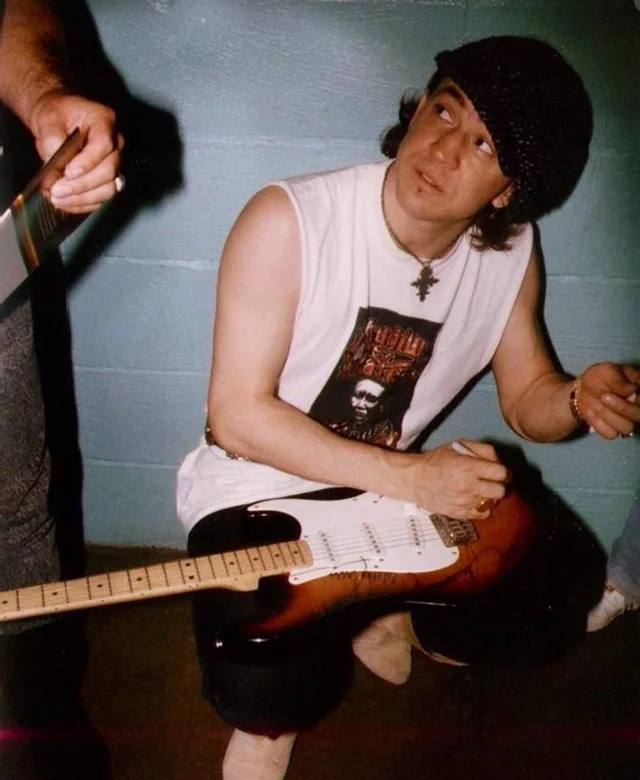
The year 1990 is etched into the collective memory of blues-rock fans as the moment the music world went quiet. In the early hours of August 27, a thick blanket of fog shrouded the Alpine Valley Resort in Wisconsin. A helicopter carrying the legendary Stevie Ray Vaughan took off into the dark, only to collide with a hillside just moments later. In an instant, one of the most blistering guitarists to ever grace a stage was silenced forever. The news spread like wildfire through the wires, leaving millions who had championed his meteoric rise from the smoky bars of Texas to the global spotlight in a state of absolute disbelief.
Yet, even amidst the absolute devastation of that night, there was a chillingly quiet miracle. While the world mourned the loss of a man whose fingers seemed to be conduits for the spirits of the old blues masters, his most faithful companion survived unscathed. Tucked away inside a tour truck, far from the wreckage, sat Lenny, his beloved 1965 Fender Stratocaster. It was the guitar he had gifted to his wife, Lenora, and the instrument that had birthed some of his most tender, soul-baring melodies. To many fans, the fact that Lenny remained untouched felt like a poetic, if haunting, testament to the endurance of his art.
Stevie Ray Vaughan was more than just a virtuoso; he was a bridge between the raw, gut-wrenching tradition of the delta blues and the high-octane energy of the late twentieth century. During an era defined by the shimmering excess of MTV and the rigid structures of pop, he wore his heart on his sleeve and his influences on his guitar strap. He was a man who lived with the intensity of a thousand suns, battling personal demons that had nearly claimed him years before his actual passing. When he took the stage at venues like the legendary Austin clubs or global festivals, he didn’t just play; he purged his entire existence through six steel strings.
Lenny was never just a tool for the trade; it was a physical manifestation of his journey. The guitar carried the scars of his performance style—the heavy gauge strings, the deep fret wear, and the sheer volume of his passion. It was a witness to his late-night sessions and his triumphant return to sobriety. When that helicopter fell, it felt as though the bridge he built between the past and the future had suddenly collapsed, yet the existence of that guitar provided a lingering, fragile sense of continuity for those of us left behind.
Today, decades after that fateful night, the legacy of Stevie Ray Vaughan remains untouchable. When you put on his records or catch a glimpse of old footage, you aren’t just listening to notes; you are hearing a soul that refused to be forgotten. The story of Lenny serves as a somber reminder that while our heroes are fragile and prone to the winds of fate, the echoes they leave behind in the wood and wire of their instruments continue to resonate. Turn up your speakers and listen closely, because in every bending note, the legend still lives on.